
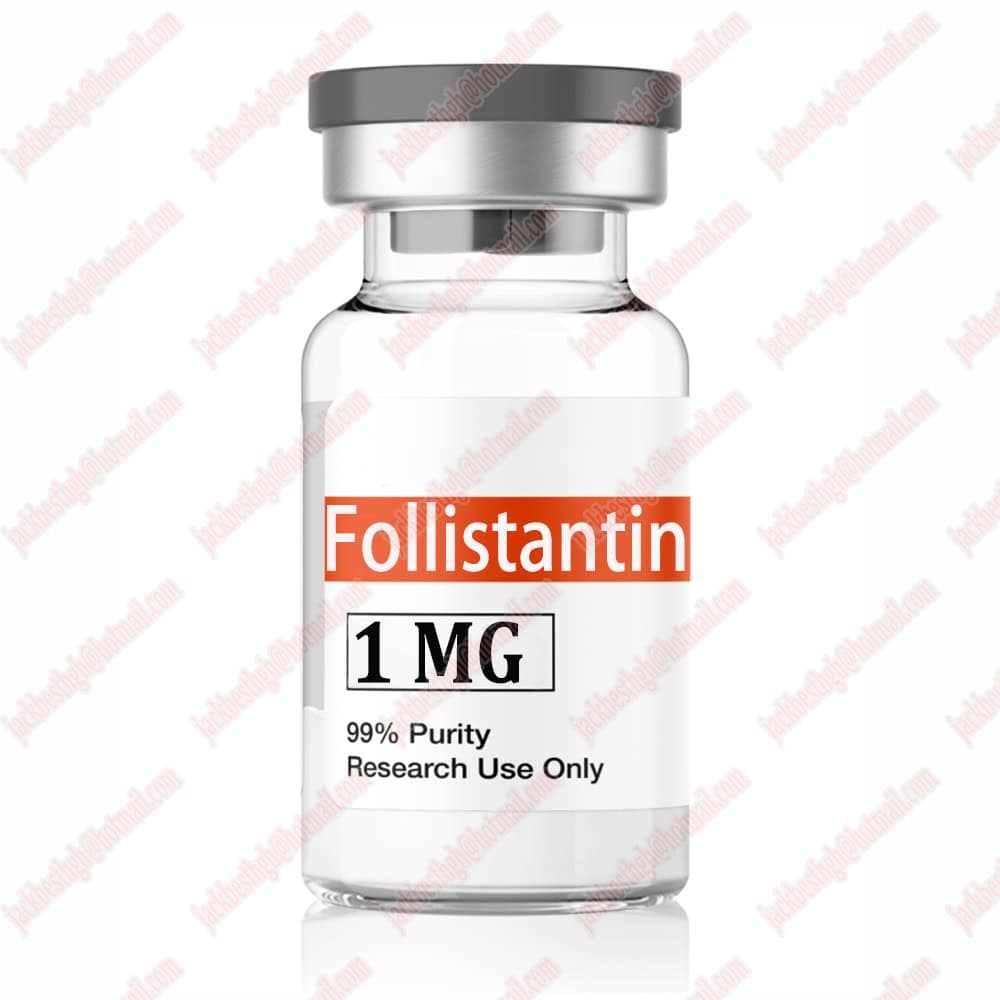
Follistantin 1mg 10 Vials–Min order 200 vials
Original price was: $580.00.$290.00Current price is: $290.00.
Follistatin 344/315 is a systemic myostatin antagonist that binds GDF-8 and activin A with near-irreversible affinity, blocking SMAD2/3 signaling to unleash satellite cell proliferation and whole-body muscle hypertrophy. The FS-315 isoform circulates systemically for broad musculoskeletal remodeling.
100% delivery
- Satisfaction Guaranteed
- No Hassle Refunds
- Secure Payments
Description
Follistatin Myostatin Antagonist for Muscle Hypertrophy Research
Mechanism Overview
The biochemical activity of Follistatin 344/315 is defined by its role as a high-affinity “ligand trap.” Initially, the protein binds directly to myostatin (GDF-8) and activin A with nearly irreversible affinity, preventing these ligands from interacting with the Activin Receptor Type IIB (ActRIIB) on muscle cell membranes. This defines the first semantic triple: [Follistatin neutralizes GDF-8]. Following this, this neutralization effectively halts the SMAD2/3 signaling pathway, which normally functions to suppress muscle protein synthesis. This establishes the second triple: [Follistatin inhibition suppresses SMAD signaling]. Thirdly, the reduction in inhibitory signaling triggers the activation and proliferation of dormant satellite cells, facilitating both hypertrophy (cell size) and hyperplasia (cell number). This forms the third triple: [Myostatin blockade drives satellite cell proliferation]. Quantitatively, FS-315 is unique because it contains a C-terminal acidic tail that reduces its affinity for heparin-sulfate proteoglycans, allowing it to remain in the bloodstream longer than other isoforms.
Overview
Follistatin (FST) is a single-chain glycosylated protein that acts as a potent regulator of the Transforming Growth Factor-beta (TGF-??) superfamily. In research models, the 344-amino acid precursor (FS-344) undergoes post-translational modification to become the serum-circulating 315-isoform (FS-315). Unlike the membrane-bound FS-288 variant, the 344/315 lineage is specifically characterized by its ability to circulate systemically, making it the primary tool for investigating whole-body musculoskeletal remodeling and the inhibition of negative growth regulators. [Follistatin binds Myostatin].
Molecular Data
- CAS Number: 129954-34-3 (Reference)
- Molecular Weight: ~35?C45 kDa (Glycosylated monomer)
- Sequence: 344 Amino Acid Precursor / 315 Amino Acid Circulating Form
- Purity: >99.0% via HPLC-UV and Mass Spectrometry
- Appearance: Sterile filtered white lyophilizate
Research Observations
- Rapid Accumulation of Lean Mass: Users report significant increases in skeletal muscle density and volume within 2 to 4 weeks of administration.
- Myogenic Stem Cell Activation: Published research indicates enhanced recovery from micro-trauma through the recruitment of new myonuclei.
- Modulation of Adipose Tissue: According to research documentation, research models show a secondary reduction in body fat as lean tissue metabolic demand increases.
- Connective Tissue Support: Aggregated data shows improved tendon and ligament integrity, likely due to the modulation of TGF-??-mediated fibrosis.
- Follicle-Stimulating Hormone (FSH) Regulation: Research models have observed a dose-dependent suppression of FSH, which is a hallmark of follistatin’s endocrine signaling.
Key Points:
Follistatin 344/315 represents a premier research tool for investigating the profound effects of systemic myostatin inhibition on muscular hypertrophy and cellular regeneration.
Frequently Asked Questions
What is the difference between Follistatin 344 and 315?
FS-344 is the precursor protein that the body processes into FS-315, which is the version that circulates in the blood to inhibit myostatin systemically.
How long does Follistatin stay in the system?
In research models, the circulating half-life of FS-315 is approximately 2 hours, but its biological impact on muscle signaling can last for several days.
Does Follistatin affect the heart?
Myostatin is also present in cardiac tissue; researchers monitor heart health closely, though standard doses in short cycles have not shown adverse cardiac remodeling.
Can I mix Follistatin with other peptides like BPC-157?
While they target different pathways, many researchers use them in tandem to study the synergy between muscle growth (FS) and tissue repair (BPC).
Why is my Follistatin vial slightly cloudy?
Glycoproteins can occasionally exhibit a slight opalescence; however, if significant particles are present, it may indicate improper reconstitution or storage.
These statements have not been evaluated by the Food and Drug Administration. This product is not intended to diagnose, treat, cure, or prevent any disease. Consult a qualified healthcare professional before use.
You must be logged in to post a review.
Related products
- Sale!
Thymosin Alpha-1 5mg * 10 Vials * 1 kit- Best Quality Thymosin Wholesale In Discount Price
Original price was: $300.00.$150.00Current price is: $150.00. - Sale!
Hexarelin Acetate 5mg 10vials- High Quality Hexarelin Wholesale In Discount Price
Original price was: $220.00.$110.00Current price is: $110.00. -
- Sale!


Reviews
There are no reviews yet.